
Grendel & me
Nobody majors in English anymore, and that's too bad

In the late winter of my freshman year in college, when it was time to pick courses for spring quarter, I made a momentous decision. Without telling my parents, I signed up for English 10A, which was the first of three survey courses required of prospective English majors.
My parents wanted me to be an engineer, because everyone in my family was an engineer. Engineering was a clear, comprehensible, and well-compensated profession. More accurately, it was a clear, comprehensible, and well-compensated profession for people who were unafraid of math and who had not blown a fuse in their physics classroom because they were passing notes during the explanation of what to do for the electricity lab. In other words, engineering was not for me.
English 10A, which covered English language literature from Beowulf through Shakespeare, required the purchase of volume 1 of The Norton Anthology of English Literature and the Department of English Style Guide. The Norton Anthology had a painting of Queen Elizabeth I on the cover and was the size and weight of a large brick. The Style Guide was a thin stapled booklet with a Hogarth engraving on the cover and terrifying injunctions about adhering to MLA style guidelines OR ELSE inside.
I lived in an off-campus apartment that year because I sent in my housing application approximately two and a half months after the deadline, long after the dorms had been filled with students who read important letters from the university and followed directions. My apartment building was on Landfair Ave., across the street from a row of fraternity houses that played thumping music on Friday and Saturday nights and smelled like stale beer and bad decisions on Sunday mornings.
The first assigned paper in English 10A—five typed, double-spaced pages—asked us to consider how the Old English epic poem Beowulf embodied a fear of the Anglo-Saxon people. I panicked. In high school English, I was routinely rewarded for last-minute, half-hearted, half-baked assignments, but this felt different. More consequential. I had a feeling that the professor—who spoke in a rich baritone with a vaguely British accent, who enunciated his words with intimidating precision—would see right through any last-minute bullshit, and so, for the first time in my life, I started writing a paper three days before it was due.
It was hard going. I started and re-started half a dozen drafts. I didn’t know what the Anglo-Saxon people were afraid of, because they were all dead. It was possible that they didn’t like being dismembered by a rampaging monster in the dead of night—I mean, who does?—but where was the textual evidence?
Nobody wants to read about the torment of writing a five-page academic essay, so I’ll spare you the details. I’ll just say that in my desperation, I pivoted from writing stupid shit in my notebook to writing out every quote from Beowulf that seemed even remotely relevant to my as-yet unformed thesis. The day before the paper was due, I found a way in.
The world of Beowulf is pretty straightforward. Think Game of Thrones, but more primitive—a fifth century Nordic kingdom ruled by King Hrothgar, populated with manly men who strap on their armor and fight by day and remove their armor and drink mead by the fire at night. There’s also Grendel, a terrifying monster who lives in a serpent-infested lake and, every now and again, visits the mead hall in the dead of night and murders some of the men.
Grendel—described repeatedly as a “rover of borders” and a “terrible walker alone”—exists on the periphery. He does not follow the custom of paying wergild—man price—for those he has killed, though he seems to know about it. He’s a perversion of what it means to be human; dark and lurking where the mead hall is warm and welcoming, chaotic and deadly where there is order. Recognizably human, but also not. That was the fear: to be neither here nor there. To be cast out.

Beowulf is an old text—the manuscript dates back to somewhere between 975 and 1025. The story itself is much older. But when you’re a young person (I was 18 that spring), all you see is the story in front of you, and the deadline, and your typewriter. It did not occur to me that I, too, was on the periphery, in my studio apartment on Landfair Avenue with the thumping music from the fraternity houses in the background. I did not fully recognize that I, too, longed for warmth and camaraderie, that I yearned to be with my own kind.
I would find my own kind eventually, in the messy, noisy newsroom of The Daily Bruin, with its ringing phones and clacking keyboards and occasional bursts of laughter, and at seminar tables in grad school, with others who loved books as much as I did. I would learn to look for pattern and symmetry, for repetition and variation. I would learn how to properly cite a scholarly article in volume 18 of a literary journal, how to footnote, how to title a paper in a way that was both arch and serious (My favorite, from junior year: “Take My Hand, Take My Whole Life Too: Dismemberment, Madness, and Death in Shakespeare’s Titus Andronicus”). I would come to recognize that Grendel might have been a fiction of the Anglo-Saxon imagination, but the fear of the darkness outside the mead hall, of belonging nowhere and to no one—that was timeless, both in literature and in life.
In the spring of 1987, I didn’t know any of that. All I knew was how giddy I was when I received an A- on my first paper in English 10A. The professor wrote “excellent work” and called my argument “rigorously constructed.” It would have been too perfect if he had called it “rigorously engineered,” but in my imagination, that’s what he did.
Updates:
Last Sunday, I was at the Bay Area Book Festival in Berkeley to talk about road trips, pop tarts, and families with Kevin Wilson, whose new book, Run for the Hills, is out in paperback. It was so, so fun! Here we are in the green room at the Freight in Berkeley with our fantastic moderator, Julie Coryell.
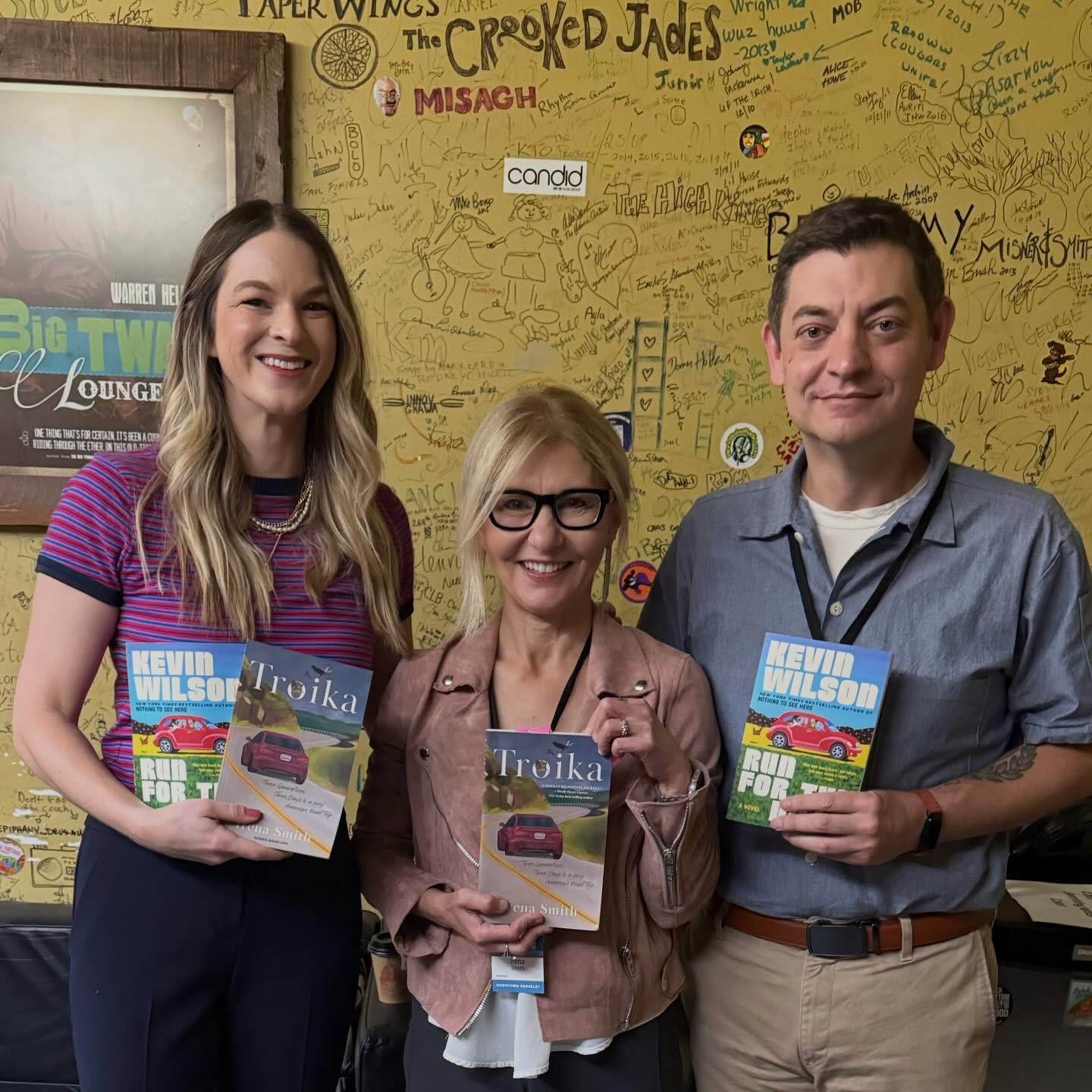
If you’re saying to yourself, “Gosh, I wish I lived closer and could hear Irena talk about her new book!” fear not: you can come to a Virtual Book Club featuring Troika next Thursday, June 11 at 4 pm PT/7 pm ET. It’s free and open to the public! Register here: https://www.namw.org/june-2026-virtual-book-club/. And if by some miracle you missed my nattering about Troika for the past year or so, you can order it here.

—
Take My Hand, Take My Whole Life Too: Dismemberment, Madness, and Death in Shakespeare’s Titus Andronicus! LOVE that. You're hilarious. And smart. And I my dear, couldn't finish Chemistry in 11th great. Completely overwhelming, and I got to my breaking point on the day Mrs. Horowitz remarked on the angry, about-to-pop zit right in the middle of my forehead, in front of my whole class. She was concerned that I might not be aware of it. The thing was like a vestigial conjoined twin being born from my skull. I marched out of the class, down to the principal's office and demanded to be removed from her class and any future science course. xo
I too have both of my Norten Anthology books- one of English Literature from my High School British Literature class (cover has a grid of ALL the famous poets/authors) and one of Poetry, from college which, strangely, has no poet portraits but what looks like a painting of the blurry ruins of a church. They will be kept but I'll tell you what, our Brit Lit teacher in high school was a soft, baritone spoken gentleman whose melodious voice nearly did us all in during fourth period, AFTER LUNCH. We were all practically comatose until called upon to comment and Beowulf was as terrifying to absorb as you say- that horror story kept us awake.